My mother turned seventy on March 4, 2023, and spent the morning sneezing through her own birthday party. I had ordered a sunflower-and-daisy mix from FTD for the occasion, the listing photo was still saved on my phone. What showed up on her porch was a lily arrangement instead, and she is allergic to lilies. Nobody called ahead to ask if that swap was okay. That single delivery is the reason I started photographing every box next to its listing photo before I even bring it inside, and it's why the FTD row below spells out its actual notification rule rather than the vague version I used to assume was true.
I built this page after going back through three years of orders and reading each brand's own substitution language for myself, not the marketing copy, the actual policy text. A few of the pages I'd originally cited had moved or gone dark since I first wrote this up, so I re-checked every link against what's live right now. One brand, The Bouqs Co., doesn't have a public substitution policy I could actually pin down and verify anywhere, help center, terms, or otherwise, so I've left it out of the table entirely rather than guess at what it probably says. I'd rather show you nine confirmed answers than ten where one is a shrug.
The ProFlowers row below is a good example of why I stopped trusting my memory on this. I'd had it down as a clean equal-or-greater-value promise for years, but when I actually reread their current customer service page for this update, that specific language isn't there anymore, just a promise to fill the order "as similar as possible" and a fallback of re-delivery or refund if you're unhappy. That's close to what happened when the apology bouquet I sent my sister-in-law in January 2025 arrived with white carnations where the listing had shown peach ranunculus. No one warned me it was coming. I called, and they redid it.
On this page
Standard Industry Substitution Protocols
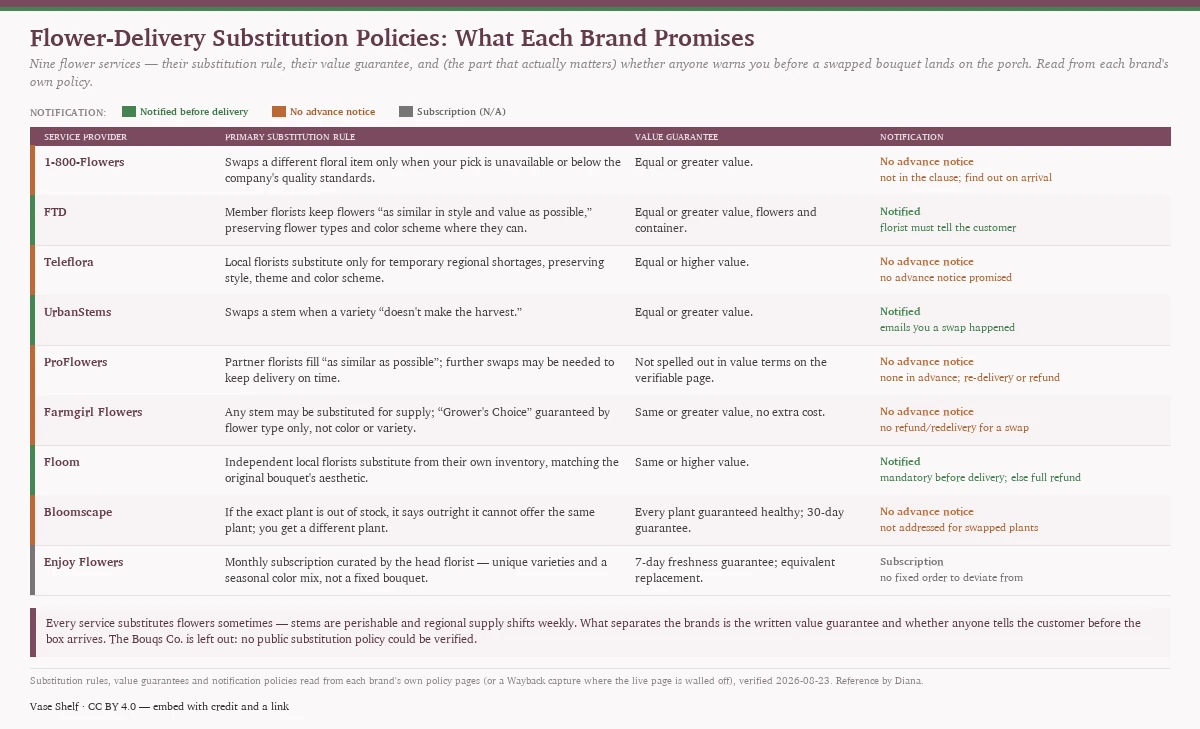
Every service in this industry substitutes flowers sometimes. Fresh stems are perishable and regional supply shifts week to week, so a florist somewhere along the chain runs short and reaches for something else. What actually separates one brand from another is not whether substitution happens, it's whether the company puts a real value guarantee in writing, and whether anyone tells the customer before the box shows up. My mother's birthday taught me that "equal or greater value" on a policy page and "someone actually called or emailed you" are two completely different promises. The table below keeps those apart on purpose.
Substitution Policies by Brand
These are the current substitution terms I could verify directly on each brand's own site as of this week, not what a customer service rep told me over the phone and not what I remember from an order two years ago.
| Service Provider | Primary Substitution Rule | Value Guarantee | Notification Policy |
|---|---|---|---|
| 1-800-Flowers | Swaps in a different floral item only when the one you picked is unavailable or falls short of the company's own quality standards. [1] | Equal or greater value. | Not addressed in the substitution clause itself. If what arrives doesn't match, that's a customer service call, not a proactive notice. |
| FTD (Florists' Transworld Delivery) | Member florists are required to keep flowers "as similar in style and value as possible," preserving line-for-line and round-for-round flower types and the color scheme on the recipe wherever they can. [2] | Equal or greater value, stated for both the flowers and the container. | Required. The filling florist must tell the sending florist, who must tell the customer, whenever a substitution happens. My mother's order shows what it looks like when that step gets skipped anyway. |
| Teleflora | Local florists substitute flowers or containers only for temporary, regional availability issues, while preserving the arrangement's style, theme, and color scheme. [3] | Equal or higher value. | No advance notice promised in the policy text. You can request zero substitutions by calling ahead, but even then they won't guarantee none will happen. |
| UrbanStems | Swaps in a different stem when a specific variety, in their words, "doesn't make the harvest." [4] | Equal or greater value. | Emails you to say a swap happened. This is the one that impressed me once, an actual email landed before the recipient did. |
| ProFlowers | Partner florists fill each order "as similar as possible" to the recipe under the company's own Substitution Policy, though further swaps may be needed to keep delivery on time. [5] | Not spelled out in value or percentage terms on the page I could verify. | None promised in advance. If you're unhappy with what arrived, the fallback is a fresh re-delivery or a full refund, which is exactly what I had to ask for. |
| Farmgirl Flowers | Any stem in a bouquet can be substituted due to natural supply. Bouquets specifically marked "Grower's Choice" are guaranteed only by flower type, not by exact color or variety. [6] | Same or greater value, at no additional cost. | None. The policy states plainly that they cannot offer a refund or redelivery for a variety, type, or color substitution. |
| Floom | Independent local florists substitute stems from their own inventory, matching the same aesthetic as the original bouquet. [7] | Same or higher value. | Mandatory, not just encouraged. Florists have to tell Floom before delivery, and a customer who wasn't told about a substitution in advance is owed a full refund. |
| Bloomscape | If the exact plant you ordered is out of stock, the company says outright it is "not able to offer the same plant as a replacement." You get a different plant instead. [8] | Every plant is guaranteed to arrive in good health, with the guarantee lasting 30 days. A dead or damaged arrival gets a free replacement. | Not addressed for substituted plants specifically. The 30-day window is the main promise on file. |
| Enjoy Flowers | A monthly subscription curated by the company's head florist, who picks unique varieties and a seasonal color mix rather than repeating the same fixed bouquet. [9] | A 7-day freshness guarantee. If the flowers don't hold up, they'll replace the arrangement with an equivalent one. | There's no fixed order to deviate from each month, so there's nothing to notify you about. The variety changing is the whole model, not an exception to it. |
Key Terms and Definitions
A few terms come up across every one of these policies, so here's what they actually mean once you strip out the marketing language.
- Focal Flowers
- The primary, most prominent flowers in an arrangement (e.g., roses, lilies, sunflowers). Most policies attempt to avoid substituting these unless necessary, though "necessary" is decided by the florist, not the customer.
- Filler Flowers
- Smaller blooms used to add volume and texture (e.g., baby's breath, waxflower). These are the most frequently substituted items, and the ones least likely to trigger any kind of notice.
- Container Substitution
- Replacing a specific vase or basket shown in marketing materials with one of similar shape, material, and value if the original is out of stock.
- Look and Feel
- An industry phrase for the overall aesthetic, color balance, and dimensions of an arrangement that a policy promises to preserve during a substitution. It's a promise about the shape of the thing, not a promise that the specific flowers you saw in the photo will be the ones in the box.
Last verified: 2026-08-23
Sources
- 1-800-Flowers: About Us, Terms of Use (Substitutions)
- FTD Substitution Policy (FTD florist network)
- Teleflora: How to Place an Order (Substitution Policy)
- UrbanStems Help Center: Missing or Incorrect Items
- ProFlowers: Customer Service
- Farmgirl Flowers: Refunds (Substitutions)
- Floom: Our Substitution Policy
- Bloomscape: The Bloomscape Guarantee
- Enjoy Flowers: Help Center FAQ